social app built for community and genuine connection
GOAL:
TIMELINE:
TEAM:
rebuild Kardder as a social app with a focus on community and in person interaction - research the user, pivot from dating app concept, cultivate liveliness and belonging.
5 months
CTO, 2 designers, 5 engineers
ABOUT KARDDER & I
THE PROBLEM: The Loneliness Paradox
Big cities are full of people, yet urban loneliness is at an all time high. Post COVID isolation, dating app fatigue, and performative social media left a gap: people craved authentic community, not more followers or forced matches.
Kardder's founders wanted to solve this through location based social discovery, but their first attempt, a dating app, wasn't working.
THE OUTCOME
We pivoted from dating to social discovery and community. Users who joined clubs had 2.5x higher engagement, and 4 week retention increased by 40%.
MY ROLE
I helped shape product vision, designed core flows, and built the app from the ground up alongside the CTO and our small development team.
When they reached out, I was a solo researcher in Social Psych professor, Dr. Karney's Intimate Relationships lab at UCLA, and minoring in digital humanities with a focus on user experience design. I was brought on to understand what wasn't working, chart a new direction, and help redesign the product from the ground up.
This is where I really leaned into my care for the understanding the user (people) beyond the surface — what are our desires? What are the gaps we can fill? In this case, the desire for connection, the desire for community, and for belonging. Next, was worldbuilding, how do we communicate that we understand, and are able to meet this need?
OVERVIEW
THE RESEARCH
UNDERSTANDING WHY DATING FAILED
I conducted 17 interviews with users and target users: college students, young professionals, people new to cities. I also analyzed competitive dating apps and the existing Kardder product.
WHAT I FOUND & PRIOR RESEARCH
THE INSIGHT
People weren't looking for more dating apps, and they were often using them as a last resort because there was no other tool to expand their social circles. Dating wasn't even the goal. People wanted community, belonging, and to expand their circles. Romance might happen naturally through those connections, but it shouldn't be the focus.
INDUSTRY CONTEXT - WHY SOCIAL DISCOVERY, WHY NOW
Rising loneliness, dating app fatigue, and the cultural desire for community.
Location based tech matured (maps, real-time updates, safety features).
Other platforms (dating apps, event apps, social feeds) solve pieces of the puzzle, but none combine them into authentic everyday discovery.
USER PERSONAS & NEEDS
Lily | 22 | Student
"I just moved here and I'm always looking for what's going on, but it's hard to track everything down."
Eric | 25 | Event Organizer
“I moved here a few months ago… I just want to build community.”
Omar | 28 | Software Engineer
“I have my circle, but I never know what everyone's up to. We don't have the time to coordinate.”
Needs:
A reliable feed of nearby events with easy ways to RSVP, join, or connect with others attending.
Make events visible, scannable, and seamlessly tied to connection opportunities.
Needs:
Low pressure ways to create and grow communities and connections.
Prioritize belonging and community features that feel welcoming and safe.
Needs:
A simple way to keep up with his friends' lives without intruding.
Easy way to coordinate attending events with friends.
DESIGN IMPLICATIONS
Discovery must feel organic, not transactional.
Interactions should emerge from context: location, events, shared interests, so meeting someone feels natural rather than forced.
No swiping, no high pressure mechanics.
Balance spontaneity with safety.
Real-time discovery is exciting, but users must feel in control.
Features like profile verification, privacy settings, and the ability to filter interactions are critical to building trust.
Support different communication styles, both quick connects and community building.
Some users want to grab coffee or join a pickup game today.
Others want to grow long-term groups or clubs.
Kardder must handle both ends of this spectrum to create daily utility and lasting value.
Keep inclusivity front and center
Avoid dating app tropes (e.g., pink/blue color coding, “likes,” or swipe gestures).
Use neutral, welcoming language and iconography.
Make the app resonate equally for friendships, hobbies, and professional circles.
Encourage expansion of social lives
Kardder shouldn’t feel like users are leaving existing platforms, but rather expanding their world: meeting new people, finding new events, and joining new communities.
THE REDESIGN & PRODUCT GOALS
THE FINAL DECISION
I presented my findings to the founders along with the other designer. The research was clear: users needed community, not dating. We proposed the pivot, and the founders aligned immediately - genuine connection was their mission from the start.
EXPERIENCE GOALS
Make discovery feel natural: help users connect with people, events, and communities nearby without the pressure of swiping or forced interactions.
Inclusive & welcoming: avoid dating app tropes, keep language and design centered on authenticity and belonging.
Blend spontaneity with safety: enable real-time connection while ensuring trust and user control. User verification, moderation, and private chat options ensure users feel comfortable engaging.
Create lasting value: design flows that encourage both quick interactions (events, chats) and longer-term communities (Clubs).
THE CITY IS ALIVE (MAP VIEW)
THE CHALLENGE
How do you show real-time social activity without overwhelming users or raising privacy concerns?
THE SOLUTION
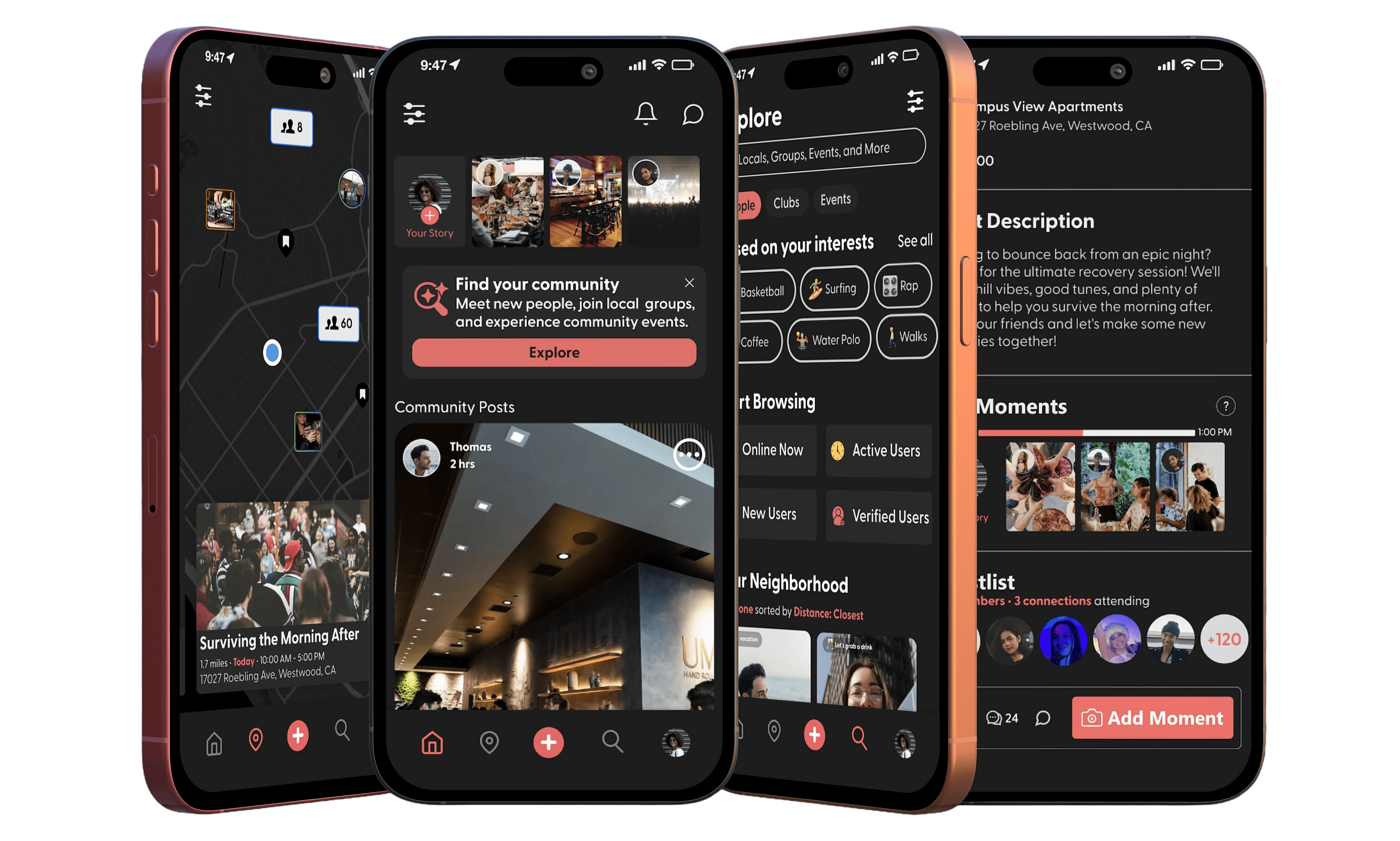
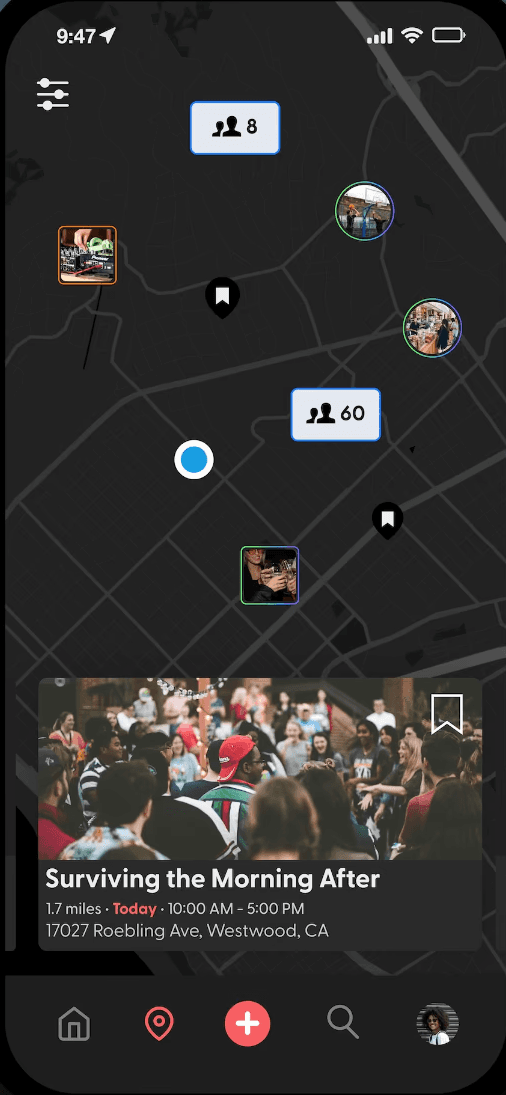
Visualize real time social energy. The map shows nearby events, gatherings, and people, giving users a spatial sense of where to go. This screen is Kardder’s differentiator, it turns the city into a live interface - shows where people and events are gathering right now, and how to get there.
Activity clusters + time based filters (now/tonight/this week) + clear visual hierarchy (events vs. user activity).
DESIGN DECISIONS
Location centered design
Share your location with specific friends, or at specific times. Your location is at the center of the map; and you view your friends and clusters of people all around you.
Organize or schedule events you'll be attending.
Activity clusters
Avatars = people; badges = groups/attendance counts; event pins = current and upcoming events.
Smart clustering keeps the map legible while hinting at energy.
Live events card
Swipes up into a carousel of nearby events/people with details (distance, start time, mutuals, validation indicators).
You can RSVP, navigate, or message without leaving the map. Events can be in app, or link to event details.
Filters for agency
Time (now / tonight / this week), vibe (chill, active, nightlife), size (1:1, small group, big crowd), and safety (verified only).
Deep link to your maps app; if multiple friends are en route, show ETAs to reduce “are you close?” friction.
Edge cases
Low density areas show “sparks” (suggested meetups you can start) or recommended clubs to join so the map never feels empty.
IMPACT
For Users:
"It feels impossible to know what's actually going on around me."
The map answered the core frustration of urban invisibility. Users could finally see where energy was gathering in real time - events, gatherings, and communities nearby that they'd otherwise never discover.
For Kardder:
Higher intent users: map interactions indicated "I want to do something NOW" vs. passive browsing
~30% increase in event RSVPs when discovered via map vs. feed
Became the key differentiator from competitors (no other platform had live social geography)
Drove daily habit formation: users opened Kardder to check of their city
EVENTS
THE CHALLENGE
How do you actually translate community and connections into the world? How do you make events feel accessible and lower the barrier to attendance?
People want to know: Who's going? What's the vibe? Is it worth my time?
THE SOLUTION
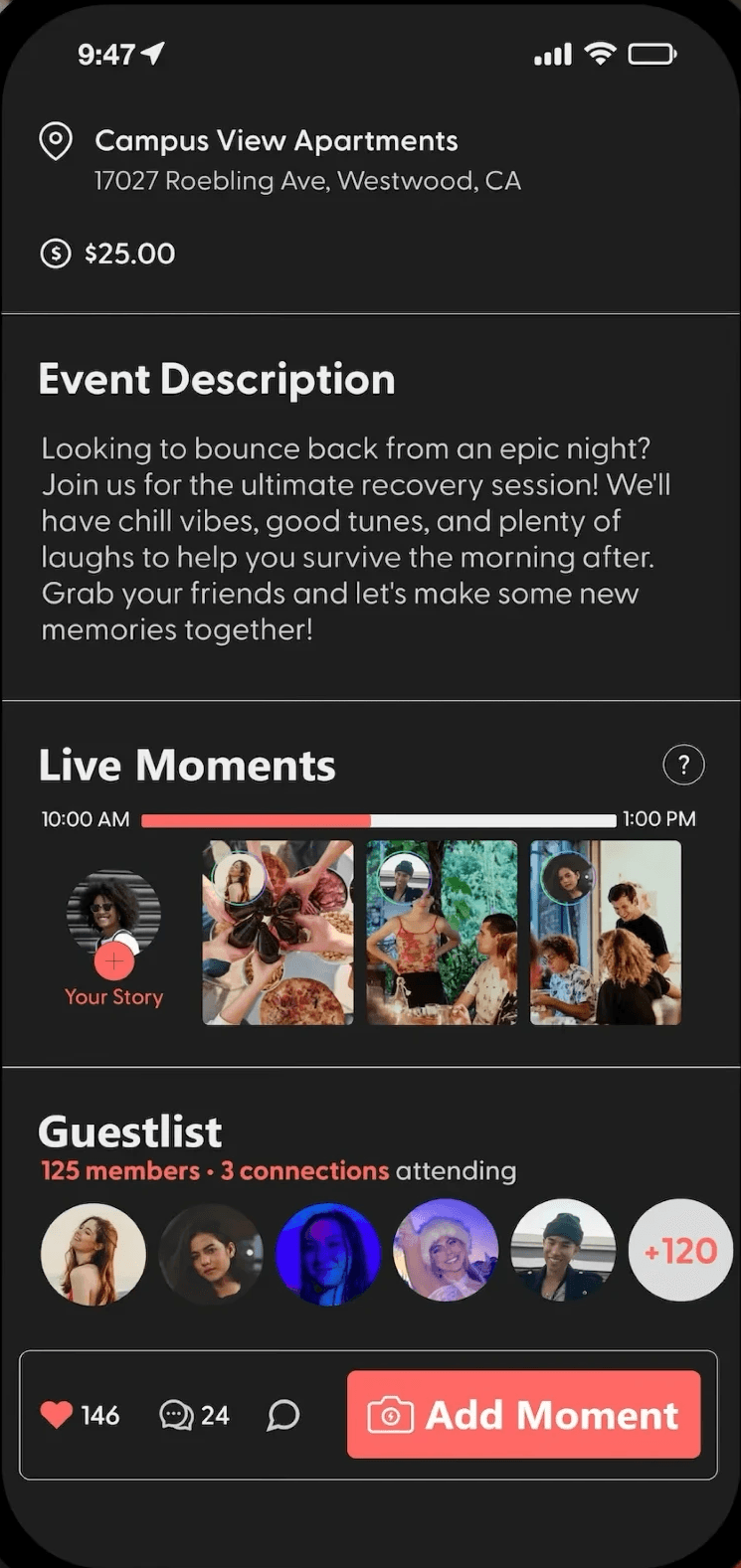
Event pages as living, breathing spaces. See if your friends are going, watch people post during the event, watch the events fill up the map.
DESIGN DECISIONS
Events hosted by clubs and community
Members can post events after identity verification. Frequent event hosts have a verification badge.
You can see a host's event history, including comments, moments, and reactions about the event from the community.
Stories row at the top
Live stories from the event that show what's actually happening, posted by both hosts and attendees.
Guestlist with friends
Shows total number of members attending
Shows your friends that are going - familiar faces lower anxiety
Participation before commitment
You can engage (react, comment, see moments) before you RSVP to reduce pressure.
IMPACT
For users:
This directly addressed the research insight: "It feels impossible to know what's actually going on around me." Now users could see in real-time what events were like and who was there.
For Kardder:
Day one engagement, stronger signal data for personalization, and a clean funnel into events, DMs, and clubs.
CLUBS DRIVE RETENTION
THE CHALLENGE
Events create excitement but are transient. How do you create lasting belonging?
Clubs became the retention layer, they're recurring communities tied to shared interests (running clubs, book clubs, creative meetups). Unite long term communities (Clubs) with short term activities (Events). This is where Kardder creates a sense of belonging.
DESIGN DECISIONS
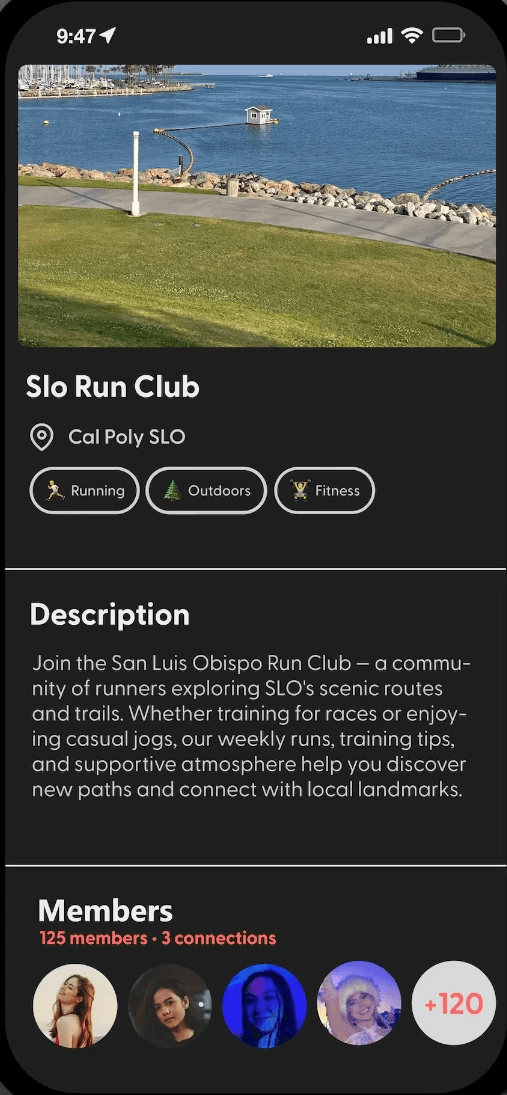
Club profiles as a hub
View the clubs you're a part of and discover new clubs to join.
Users instantly understand the group’s vibe and cadence.
Community members can choose to accept members, to tailor group sizes and to ensure safety.
Connections
Members Preview: faces + count show scale and energy while surfacing mutual connections and friends to reinforce belonging and reduce hesitation in joining.
Join the club → unlock ongoing chat, meet hosts, see future events. RSVP to an event
Events baked in
Upcoming events appear right inside the club profile; RSVPing is easy.
Past events show photos, creating a sense of community and memories (“this group really meets”).
Posts can be tagged to the clubs the memory belonged to, so your community can join the clubs you're a part of (if you choose to share).
Trust and safety
Verified hosts and visible member lists create transparency. Approval settings (open, request to join, invite only) give communities control.
IMPACT
For Users:
Transformed one time interactions into lasting relationships
Gave users a sense of belonging and identity within their city
Reduced social anxiety (familiar faces at each meetup)
Enabled organic relationship formation
For Kardder:
2.5x higher weekly active engagement for users who joined at least one club
40% higher 4 week retention for users active in clubs + events - clubs created structural loyalty
HOME FEED
THE CHALLENGE
Where should users land? The map is our differentiator, but would it overwhelm new users?
THE SOLUTION
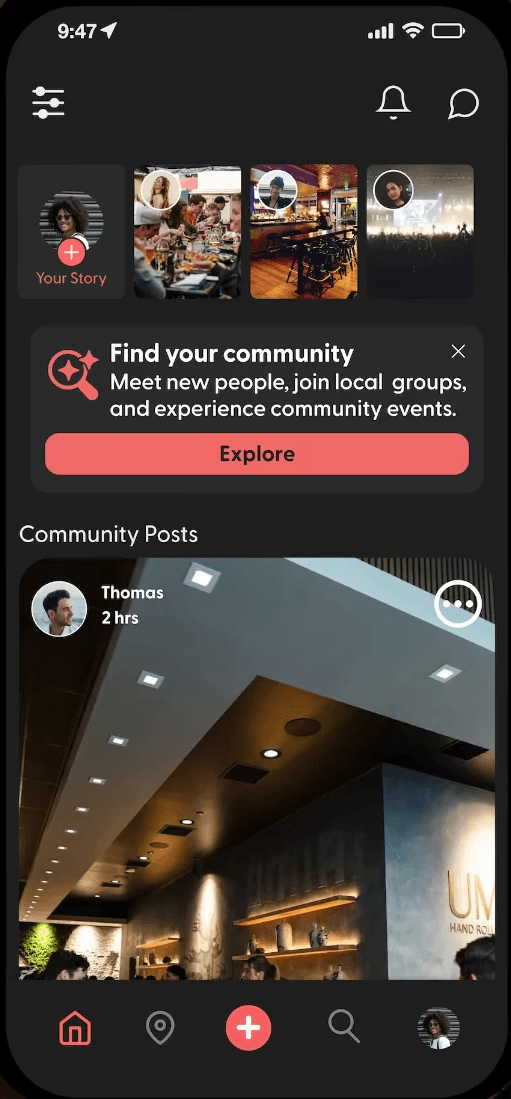
Serve as the user’s first touchpoint, reinventing the concept of a social app entirely can create confusion and frustration. Users need a some familiarity and a place to just see what’s happening, who’s posting, and quick prompts to engage.
DESIGN DECISIONS
Stories row at the top
Mirrors familiar patterns (Instagram/Snap), but tailored for local events and community. This makes it easy for users to dip in.
quick photo/video posts expire in 24h; tapping opens a stack with reactions and “Message host” CTA. Low-pressure way to signal “I’m here / this is happening.”
Find Your Community Prompt
Directly encourages new users to explore, making social expansion less intimidating.
Dynamic prompt that changes based on activity level (e.g., “New in town?” “Clubs near you” “Tonight’s events”), turning first-session uncertainty into a single clear action.
Community post feed
Prioritizes authentic, in the moment updates (photos, events) over polished content, emphasizing realness.
Ranking = proximity × freshness × social relevance
Blend distance, time, and soft graph (mutuals, clubs you follow) to prioritize posts you can actually act on.
RSVP, Save, Share, DM host. Every interaction updates recommendations (more of what you attend / less of what you hide).
Safety hooks baked in
Verified badge surfaces first; “report/mute” always 1 tap away; events show host verification and venue info.
IMPACT
For Users:
Immediate sense of place and familiarity. Lower barrier to engagement.
Made community content visible and accessible
Created ambient discovery without requiring immediate action
For Kardder:
Increased post engagement, time in app and reduced bounce rate for new users (familiarity and less overwhelm)
Progressive disclosure funnel: browse feed → click into event → RSVP → attend
Balanced innovation (map) with familiarity (feed) for user acquisition
THE RESULT
IMPACT
Feature
Problem Solves (User)
Business Impact (Kardder)
Map
"I don't know what's going on around me"
30% higher RSVPs, daily habit formation, key differentiator
Feed
"I hate feeling lost"
Lower bounce rate, progressive disclosure funnel, content moat
"I don't have the community"
2.5x engagement, 40% higher retention, structural loyalty
Safety
"I get anxious about meeting strangers"
Removed primary barrier, enabled core behaviors, brand trust
Events
"It's hard to plan things and see my friends"
Higher RSVP to attendance conversion, UGC engine, viral loops
No Vanity Metrics
"I'm tired of performing"
Higher posting rates, authentic content, anti-Instagram positioning
REFLECTION
WHAT I LEARNED
Research drives strategy.
My research didn't just inform design, it shaped the entire product. Listening to what users actually needed (community, not dating) gave us a clear vision of the gap to fill in people's lives, and add actual value.
Framing unlocks potential.
The location based social discovery concept was sound, but framing it as dating created the wrong incentives and missed what users wanted. Reframing, and rebuilding it as community made everything click.
Safety enables connection.
Trust isn't a feature, it's the foundation. Users can feel when a product prioritizes them. Without verification, visibility, and control, people won't meet strangers in real life.
Community solves loneliness.
Users came for events but stayed for clubs. The real problem wasn't "What should I do tonight?" but "How do I build the social circle I'm missing?"
Founding design as my first role.
I learned to think like a product builder. I got to be fully involved in the process at my first opportunity: research that shapes strategy, collaborating with founders and engineers, and driving a product from redesign to launch.